Why Choose Square FRP Cooling Towers in Ghaziabad for Efficient Heat Dissipation?
Industrial processes generate substantial heat, and controlling that heat is essential for maintaining equipment performance and process stability. A cooling tower transfers unwanted heat from circulating water to the atmosphere, helping industrial systems operate within the required temperature range. For businesses evaluating Square FRP cooling towers in Ghaziabad, factors such as corrosion resistance, structural durability, maintenance, footprint, and cooling performance deserve careful consideration. Square FRP cooling towers have become a practical option for several industrial applications because FRP, or Fibre Reinforced Plastic, combines strength with resistance to many common environmental and chemical conditions. However, selecting the right tower requires more than simply choosing a material. Capacity, water flow, operating temperature, installation conditions, and maintenance requirements should all match the application.
For faster information, direct chat with us on WhatsApp.
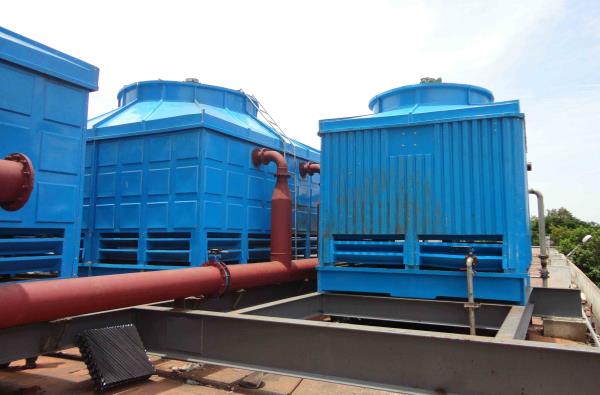
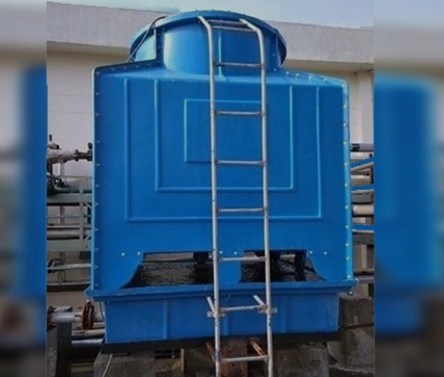
Square FRP cooling towers in Ghaziabad provide an effective way to remove heat from industrial circulating water. Their FRP construction offers corrosion resistance and relatively low maintenance, while the square configuration can suit facilities requiring practical installation and efficient use of available space. The correct model depends on heat load, water flow, ambient conditions, and operating requirements.
What Is a Square FRP Cooling Tower?
A square FRP cooling tower is a heat-rejection system that uses circulating water and airflow to reduce water temperature. Hot process water enters the tower and distributes over a fill material. As air moves through the tower, a portion of the water evaporates. This evaporation carries heat away, while the cooled water collects in the basin and returns to the industrial process.
The tower’s FRP construction uses a resin and fibre-reinforcement system designed to provide structural strength and resistance to moisture and corrosion. The square configuration also offers a practical layout for many industrial sites.
Depending on the design, cooling towers can use different airflow arrangements, fans, fill types, and water distribution systems. Therefore, the tower should always be selected according to the actual application rather than appearance or size alone.
Why Consider Square FRP Cooling Towers in Ghaziabad?
Ghaziabad has a strong industrial presence, with facilities operating across manufacturing and processing sectors. Industrial cooling systems in such environments need to withstand regular exposure to moisture, chemicals, heat, and outdoor conditions.
Here are some reasons FRP square towers can be worth considering.
1. Corrosion Resistance
Corrosion can become a significant concern when cooling equipment remains exposed to water and humid conditions. FRP does not rust like conventional steel.
As a result, an appropriately designed FRP tower can be useful in environments where corrosion resistance is an important equipment consideration. However, chemical compatibility still matters. The water chemistry and any treatment chemicals used in the system should be evaluated before selecting materials.
2. Efficient Heat Dissipation
The fundamental purpose of a cooling tower is to reject heat from circulating water. A properly designed tower uses effective water distribution, adequate airflow, and suitable fill material to promote heat and mass transfer.
This means the tower can help maintain the temperature required by connected equipment or industrial processes. Actual cooling performance depends on factors such as heat load, water circulation rate, entering and leaving water temperatures, wet-bulb temperature, and tower design.
3. Practical Industrial Construction
Square cooling towers can provide a straightforward footprint for industrial installations. Their configuration may work well where equipment needs to fit into an organized plant layout.
However, available floor space should not be the only consideration. Engineers should also account for airflow clearance, access for maintenance, fan discharge, water connections, electrical requirements, and safe working areas.
4. Reduced Corrosion-Related Maintenance
FRP can reduce maintenance concerns associated with rust and corrosion of metal structures. That does not mean an FRP cooling tower is maintenance-free.
Regular inspection remains important. Operators should check the fan and motor, water distribution system, fill, drift eliminators, basin, nozzles, fasteners, and other components according to the manufacturer’s maintenance recommendations.
Applications of Square FRP Cooling Towers
Square FRP cooling towers can be considered for a variety of industrial and commercial cooling requirements. Typical applications may include:
- Manufacturing plants
- Process industries
- HVAC and centralized cooling systems
- Plastic and injection-moulding facilities
- Chemical processing applications
- Machinery and equipment cooling
- Power and utility-related systems
- Food and beverage processing, where the system design is appropriate
The exact tower specification should depend on the process. A cooling tower designed for one heat load and water flow should not automatically be used for another application.
How to Select the Right Cooling Tower
Choosing a cooling tower based only on nominal capacity can result in an unsuitable system. Before purchasing, discuss the application with a qualified cooling-tower supplier or engineer.
Consider These Key Parameters
Heat load: Determine how much heat the tower needs to reject under actual operating conditions.
Water flow rate: The tower must accommodate the required circulating-water flow without compromising distribution.
Temperature range: The difference between hot-water inlet temperature and cooled-water outlet temperature is an important design parameter.
Ambient conditions: Local wet-bulb temperature has a major influence on cooling-tower performance. Seasonal conditions should also be considered.
Installation space: Check the tower footprint as well as required airflow and service clearances.
Water quality: Hardness, dissolved solids, pH, biological growth, and chemical treatment can affect tower performance and component life.
Maintenance access: Fans, motors, fill, nozzles, and water distribution components need practical access for inspection and servicing.
For businesses comparing Square FRP cooling towers in Ghaziabad, these technical factors are more useful than selecting a model based solely on price.
Maintenance Practices That Support Long-Term Performance
Even a well-designed cooling tower requires routine care. A practical maintenance program should include regular visual inspections and cleaning.
Operators should monitor:
- Water distribution and nozzle performance
- Fill condition and scaling
- Basin cleanliness
- Fan and motor operation
- Vibration or unusual noise
- Drift eliminators
- Water treatment parameters
- Corrosion or physical damage to connected components
Water treatment also plays an important role. Poor water quality can lead to scale, fouling, corrosion in susceptible components, and microbiological growth. A suitable water-management program can therefore help maintain heat-transfer performance and system hygiene.
Why Local Support Matters in Ghaziabad
Purchasing a cooling tower is not simply a product transaction. Installation, commissioning, troubleshooting, spare components, and maintenance can all influence the long-term experience.
A supplier serving Ghaziabad and nearby industrial areas can make communication and site coordination more practical. Before finalizing a system, ask for technical specifications, operating conditions, warranty terms, installation requirements, and recommended maintenance procedures.
Most importantly, provide accurate process information to the supplier. Better input data allows the cooling tower to be selected and configured more appropriately for the intended application.
Frequently Asked Questions
What are the main advantages of an FRP cooling tower?
FRP cooling towers offer corrosion resistance, structural strength, and suitability for many outdoor and industrial environments. Unlike ordinary steel, FRP does not rust in the same way. However, material compatibility depends on the operating environment, so water chemistry, temperature, chemicals, and mechanical requirements should be reviewed before selection.
Are square cooling towers suitable for industrial applications?
Yes, square cooling towers can be suitable for many industrial cooling applications when properly designed and sized. Their suitability depends on the required heat-rejection capacity, circulating-water flow, temperature range, ambient conditions, and installation layout. A qualified supplier should evaluate these parameters before recommending a specific tower configuration.
How do I choose a cooling tower for my Ghaziabad facility?
Start by determining the heat load, water flow rate, hot-water temperature, required cold-water temperature, and site conditions. Also consider water quality, available space, maintenance access, and electrical requirements. Sharing accurate operating data with a cooling-tower manufacturer or engineer helps ensure that the selected system matches the process.
How often should an FRP cooling tower be maintained?
Cooling towers need routine inspection rather than maintenance at one fixed interval for every installation. Fan assemblies, water distribution, fill, basin, nozzles, drift eliminators, and water quality should be checked according to operating conditions and manufacturer recommendations. More frequent attention may be necessary where scaling, fouling, or heavy industrial contamination occurs.
Can FRP cooling towers handle demanding industrial environments?
FRP towers can be well suited to many demanding environments because the material offers good resistance to moisture and corrosion. However, no cooling tower material is universally suitable for every process. Chemical exposure, operating temperature, water chemistry, structural loads, and environmental conditions should be evaluated before choosing the FRP grade and tower configuration.
Conclusion
Selecting Ice Drop Cooling Towers can directly influence process stability, equipment protection, and ongoing maintenance requirements. Square FRP cooling towers in Ghaziabad can be a practical choice for industrial facilities seeking a corrosion-resistant construction combined with effective heat rejection and a functional square footprint. However, the best tower depends on actual heat load, water flow, temperature conditions, water quality, and installation requirements.
Before making a purchase, compare technical specifications rather than relying only on initial cost. Discuss your operating conditions with an experienced cooling-tower supplier, confirm the required capacity, and plan for proper installation and routine maintenance. For facilities in Ghaziabad and surrounding industrial areas, exploring the right FRP cooling-tower configuration can be an important step toward dependable process cooling.