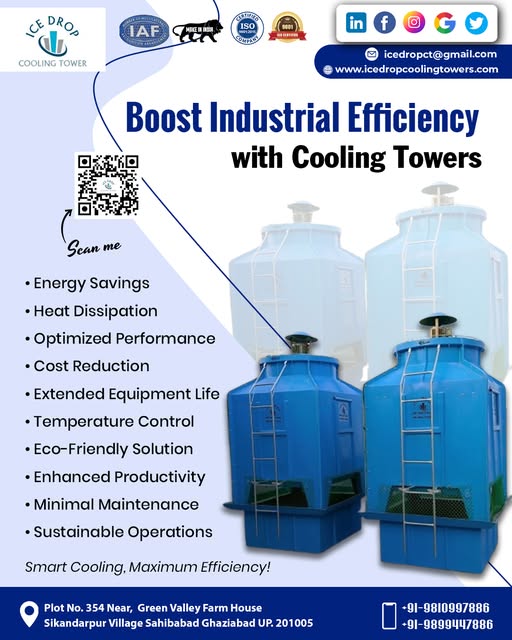
How Square FRP Cooling Towers in Sahibabad Improve Industrial Cooling Efficiency
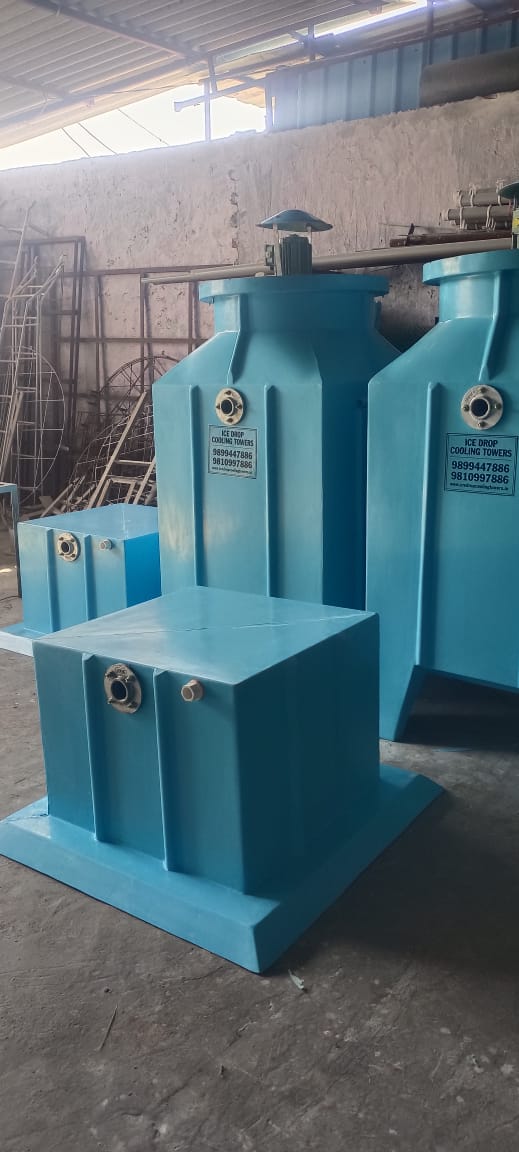
Industrial processes often generate substantial amounts of heat. Without an effective cooling system, excessive heat can affect equipment performance, production stability, and operating conditions. This is where Square FRP Cooling Towers in Sahibabad can play an important role. Designed to transfer unwanted heat from circulating water to the atmosphere, FRP cooling towers are widely used in manufacturing and process industries. Their construction, cooling mechanism, and configuration can make them suitable for facilities that require dependable heat rejection without unnecessarily complicated maintenance.
For faster information, direct chat with us on WhatsApp.
Square FRP Cooling Towers in Sahibabad improve industrial cooling by using evaporation and airflow to remove heat from circulating water. Their corrosion-resistant FRP construction, effective heat-transfer surfaces, and adaptable configurations can support process cooling applications. Actual efficiency depends on correct sizing, water distribution, airflow, ambient conditions, water quality, and regular maintenance.
How Does a Square FRP Cooling Tower Work?
A square FRP cooling tower uses a combination of water distribution, airflow, and evaporation to reduce the temperature of circulating water.
Hot process water enters the tower and is distributed over the fill material. At the same time, air moves through the tower. A small portion of the water evaporates, carrying heat away with it. The cooled water collects in the basin and returns to the industrial process.
The efficiency of this process depends on several factors, including:
- Water flow rate
- Airflow
- Ambient temperature and humidity
- Fill design
- Fan performance
- Water distribution
- Cooling tower approach and range
Because these factors work together, selecting a tower based only on physical size is not enough. The cooling requirement of the specific application should guide the selection.
Why Square FRP Cooling Towers in Sahibabad Can Improve Efficiency
1. Efficient Heat Transfer
The primary purpose of a cooling tower is to reject heat efficiently. Properly designed fill material increases the contact area between water and air, allowing heat transfer and evaporation to take place effectively.
This can help maintain the required process-water temperature when the tower is correctly sized for the application.
2. Corrosion-Resistant FRP Construction
FRP, or fibre-reinforced plastic, is commonly used for cooling tower components because it offers resistance to corrosion and moisture-related deterioration.
This can be particularly useful in industrial environments where equipment is regularly exposed to water, humidity, and varying operating conditions.
However, FRP does not eliminate the need for maintenance. Fans, motors, pumps, nozzles, fill material, electrical components, and water systems still require periodic inspection.
3. Practical Use of Available Space
Square cooling tower designs can offer a practical configuration for industrial sites where equipment layout and available floor space matter.
Before installation, the facility should consider access for maintenance, airflow around the tower, piping routes, electrical requirements, and the location of nearby heat-producing equipment.
4. Consistent Process Cooling
Industrial equipment often needs water within a particular operating-temperature range. A correctly selected cooling tower can help control this temperature by continuously rejecting excess heat from the circulating water.
This is important for processes involving machinery, HVAC systems, compressors, moulding equipment, chemical processes, and other heat-generating applications.
5. Suitable for Different Industrial Applications
A square FRP cooling tower can be considered for a range of applications, depending on the required capacity and operating conditions.
Potential applications include:
- Plastic and injection moulding units
- HVAC and central cooling systems
- Manufacturing facilities
- Chemical processing
- Compressors and air-conditioning systems
- Power-related industrial equipment
- Process cooling systems
The correct configuration will vary according to heat load, water circulation rate, required outlet temperature, and site conditions.
Factors to Consider Before Choosing an Industrial Cooling Tower
Choosing a cooling tower should begin with the actual cooling requirement rather than simply selecting a standard model.
Cooling Load
Determine how much heat the system needs to reject. This is one of the most important parameters for cooling tower selection.
Water Flow Rate
The tower must handle the required circulation rate without compromising water distribution or cooling performance.
Temperature Range
Consider the temperature of water entering and leaving the cooling tower. The difference between these temperatures is commonly referred to as the range.
Approach Temperature
The approach is the difference between the cooled-water temperature and the entering wet-bulb temperature. A smaller approach generally requires greater tower performance and should be considered during system design.
Site Conditions
Local ambient conditions influence cooling performance. Temperature, humidity, altitude, and airflow around the installation area should therefore be evaluated.
Maintenance Access
A cooling tower needs periodic cleaning, inspection, water treatment, and mechanical maintenance. The installation should allow technicians to safely access important components.
Maintenance Practices That Support Cooling Efficiency
Even a well-designed cooling tower can lose performance when maintenance is neglected.
A practical maintenance program should include:
- Inspecting and cleaning fill material
- Checking water distribution nozzles
- Monitoring fan and motor operation
- Inspecting belts, bearings, and other moving components where applicable
- Cleaning the basin and removing accumulated debris
- Monitoring water quality and treatment
- Checking for unusual vibration or noise
- Inspecting FRP surfaces and structural components
- Reviewing operating temperatures and water flow
Water treatment is particularly important because scale, corrosion, and biological growth can interfere with heat transfer and water circulation.
How to Improve Cooling Tower Performance
Installing an efficient tower is only one part of the solution. Operating practices also influence performance.
Operators can monitor inlet and outlet water temperatures, airflow, water levels, fan operation, and overall system performance. Sudden changes can indicate problems such as fouling, blocked nozzles, reduced airflow, or mechanical issues.
It is also useful to compare actual operating conditions with the design conditions specified for the cooling tower. If the process load changes significantly, professional evaluation may be necessary to determine whether the existing system remains appropriately sized.
Choosing a Cooling Tower Supplier in Sahibabad
When comparing suppliers, look beyond the tower’s advertised capacity. Ask for technical information relevant to your application, including cooling capacity, water flow, temperature conditions, fan specifications, materials, dimensions, and installation requirements.
A supplier should also be able to discuss maintenance requirements and help determine whether the proposed configuration matches the site’s operating conditions.
For industries in and around Sahibabad, considering local service availability can also simplify inspection, maintenance, replacement of components, and technical support.
Frequently Asked Questions
What are the main advantages of an FRP cooling tower?
FRP cooling towers offer corrosion resistance, relatively lightweight construction, and suitability for wet industrial environments. Their performance still depends on proper sizing, airflow, water distribution, fill condition, and maintenance. FRP construction should therefore be considered alongside the complete cooling system rather than as the only selection criterion.
How do I choose the right cooling tower capacity for my factory?
Start with the heat load, circulating-water flow rate, required inlet and outlet temperatures, and local ambient conditions. The required cooling range and approach should also be considered. A cooling tower manufacturer or qualified cooling-system professional can use these parameters to determine an appropriate configuration.
Are square cooling towers suitable for manufacturing industries?
Yes, square cooling towers can be suitable for many manufacturing applications when their capacity and configuration match the process requirements. They may be used for equipment and processes that require continuous heat rejection. The specific application, water flow, heat load, installation space, and operating conditions should be evaluated before selection.
How often should an FRP cooling tower be maintained?
There is no single maintenance interval suitable for every installation. Routine visual checks should be combined with scheduled cleaning, water-quality management, mechanical inspection, and performance monitoring. The operating environment and water conditions can affect maintenance frequency, so the manufacturer’s maintenance recommendations should also be followed.
Where can industries find cooling tower solutions in Sahibabad?
Industries can compare cooling tower manufacturers and suppliers serving Sahibabad by reviewing their technical capabilities, product specifications, installation support, and after-sales service. Before ordering, provide the supplier with accurate information about heat load, water flow, temperature requirements, and site conditions so the proposed tower can be evaluated properly.
5 FAQs
Frequently Asked Questions
What are the main advantages of an FRP cooling tower?
FRP cooling towers offer corrosion resistance, relatively lightweight construction, and suitability for wet industrial environments. Their performance still depends on proper sizing, airflow, water distribution, fill condition, and maintenance. FRP construction should therefore be considered alongside the complete cooling system rather than as the only selection criterion.
How do I choose the right cooling tower capacity for my factory?
Start with the heat load, circulating-water flow rate, required inlet and outlet temperatures, and local ambient conditions. The required cooling range and approach should also be considered. A cooling tower manufacturer or qualified cooling-system professional can use these parameters to determine an appropriate configuration.
Are square cooling towers suitable for manufacturing industries?
Yes, square cooling towers can be suitable for many manufacturing applications when their capacity and configuration match the process requirements. They may be used for equipment and processes that require continuous heat rejection. The specific application, water flow, heat load, installation space, and operating conditions should be evaluated before selection.
How often should an FRP cooling tower be maintained?
There is no single maintenance interval suitable for every installation. Routine visual checks should be combined with scheduled cleaning, water-quality management, mechanical inspection, and performance monitoring. The operating environment and water conditions can affect maintenance frequency, so the manufacturer’s maintenance recommendations should also be followed.
Where can industries find cooling tower solutions in Sahibabad?
Industries can compare cooling tower manufacturers and suppliers serving Sahibabad by reviewing their technical capabilities, product specifications, installation support, and after-sales service. Before ordering, provide the supplier with accurate information about heat load, water flow, temperature requirements, and site conditions so the proposed tower can be evaluated properly.
Conclusion
Selecting the right cooling system requires more than choosing a tower based on its appearance or advertised capacity. Heat load, water flow, temperature requirements, ambient conditions, airflow, water quality, and maintenance access all influence performance. Square FRP Cooling Towers in Sahibabad can be a practical option for industrial facilities when the tower is correctly designed and matched to the process. Regular inspection and water management are equally important for maintaining reliable operation over time. If your facility is evaluating a new cooling tower, the next step is to discuss its actual operating requirements with Ice Drop Cooling Towers and select a configuration based on those conditions rather than a generic specification.